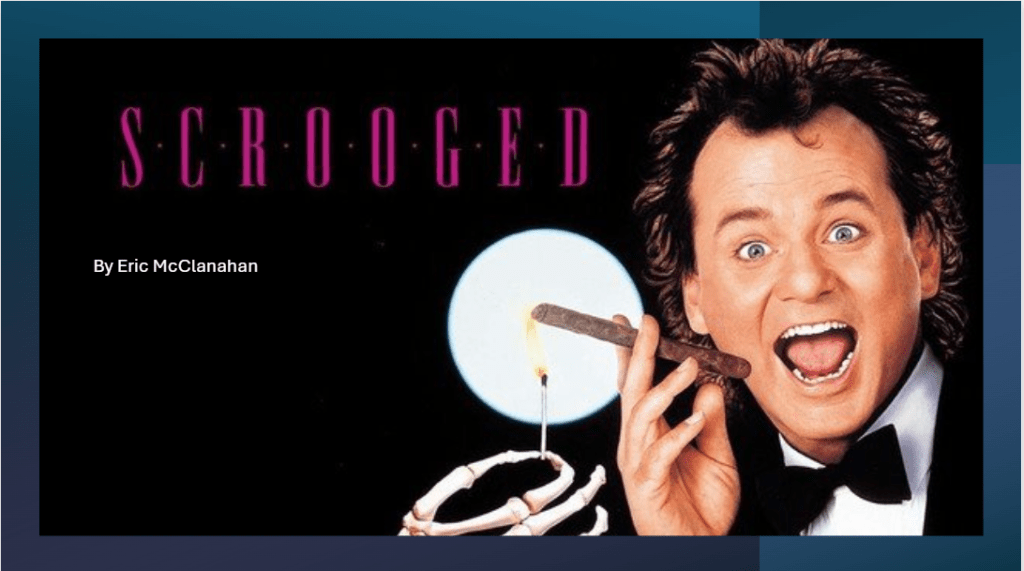
Hello, all. So, if you didn’t know, I’ve spent the past few years working towards a Bachelor’s Degree in English, and today I submitted my final assignment towards that goal: a Capstone Research Paper which I chose to write about the omission of the title “A Christmas Carol” from the 1988 film Scrooged. I was pleased with the final product so I thought I’d share. Enjoy.
Abstract
The 1988 Holiday classic film Scrooged directed by Richard Donner, starring Bill Murray, and written by Mitch Glazer and Michael O’Donoghue is a “modern” retelling of Charles Dickens’ novella A Christmas Carol. Curiously, the words “A Christmas Carol” are never featured in the film, despite its status as a metacommentary on the novella’s repeated adaptation. The film features a misanthropic television executive named Frank Cross overseeing a production of Dickens’ classic while he, himself, is visited by spirits in an effort to turn his heart toward charity and compassion. The production within the context of the film is called Scrooge and never A Christmas Carol. The purpose of this research paper is to determine what factors led to the decision to omit the novella’s original title in its adaptation.
Background information is provided about the creation of Dickens’ original novella, the many adaptations that have surfaced in the years since its creation, and the factors surrounding the ideation and production of Scrooged. Research strategies are examined and the literature unearthed and reviewed, concluding with the finding that the question has no definitive answer. The author presents their own interpretation of the phenomenon’s effect on the film’s theme and enduring legacy. An annotated bibliography elucidates the research and each source’s revelations in reference to the conclusion.
KEY WORDS: Scrooge, Scrooged, Richard Donner, Bill Murray, Charles Dickens, A Christmas Carol
Introduction
In Richard Donner’s 1988 dark comedy film Scrooged, starring Bill Murray, a television executive named Frank Cross is visited by three spirits (four if his former associate Lew Heyward is to be counted) on Christmas Eve while also dealing with the stress of mounting a live production of Charles Dickens’ timeless classic A Christmas Carol. Interestingly, the production within the film is always referred to as Scrooge, whether by the televised adverts within the film, the dialogue of its characters, or even the prop book as read by John Houseman. The film, itself, is a clear retelling of the Dickens tale, with all of the relevant plot points and overall theme of redemption. It should be curious to even a casual viewer as to why the original novella is never once referred to by its proper name, A Christmas Carol. This phenomenon seems worthy of investigation.
Adaptation is the highest form of flattery, as when a piece of literature is adapted to film, television, stage play, or graphic novel. In the era of metacommentary, when a piece of art refers to itself, it’s even easier for an adaptation to wear its influence on its sleeves. The deliberate omission of a source work’s title in metacommentary is itself a statement. It is this relationship between source material and adaptation that brings Richard Donner’s Scrooged under the microscope in the discipline of English studies. Examining the myriad reasons that an adaptation or derivation of a source might choose to distance itself from that source is at the root of the question why the words “A Christmas Carol” are never spoken aloud in the 1988 film adaptation Scrooged. Is it meant to illustrate the distance of understanding Dickens that the fictional executives within the film must experience or is it a damning distillation of the misunderstandings of the actual executives who made Scrooged, itself? Clearly there’s a disconnect between Dickens and “Scrooge” within Scrooged but who is ultimately to blame?
At times, a character can transcend their literary bounds and become emblematic of the story that introduced them principally, their name becoming shorthand for their story. This is metonymy, as in when referring to the institution of royalty as “the crown” – it distills the work into its defining characteristics. While precedent has been shown throughout history for referring to Dickens’ A Christmas Carol as Scrooge, the question to be studied is to what purpose has this metonymy been applied to the metacommentary within Scrooged? Was this a stylistic choice or one of necessity? If the decision was indeed deliberate, as one must believe it was, to whom does one attribute such a decision: the production studio, the screenwriters, or the director? What lessons can be learned from this particular adaptation and the deliberate choice to alter the original author’s chosen title?
History
A Christmas Carol. In Prose. Being a Ghost Story of Christmas by Charles Dickens was written and published in 1843 over the course of a scant six weeks under extreme financial pressure (Beete). Dickens’ story is an extension of his life’s work to illustrate the disparity between the wealthy and poor, serving as social commentary to open the hearts of those with means and power to the lives of the poor. Historians have posited that Dickens based the character of Ebeneezer Scrooge on John Elwes, an eccentric miser and member of Great Britain’s parliament in the late 18th century (Carlson). A Christmas Carol is the story of rich miser Ebeneezer Scrooge, who refuses to spend his wealth on his community or even himself, valuing money over humanity. Scrooge’s frugality jeopardizes the security of his family, his employees, and their families – most notably the young Tiny Tim, the disabled son of Scrooge’s underpaid clerk Bob Cratchit (Dickens). Scrooge is taught to value human connection by the visitation of three spirits who show him his past, present, and future, convincing him to become a steward of compassion. While the lead character of Scrooge is introduced as a miser and misanthrope, it is Dickens’ story of redemption that make it such a treasured classic. Critical analysts praise the story for its core moral message of charity and the damnation that “what we hoard for ourselves in this life we must carry in the next” (Bruner).
A Christmas Carol by Charles Dickens has been adapted countless times, with many scholars believing it to be the most frequently adapted literary work of all time. The first film adaptation of A Christmas Carol was made in 1901, though even it is believed to be an adaptation of a stage adaptation of the novella (Davidson). A living document begun three years ago on IMDb.com lists 228 film adaptations in the 145 years since the story’s publication (IMDb.com). An aggregated list on the same site finds that the most beloved versions are the 1951 film Scrooge with Alastair Sim as the titular miser and The Muppet Christmas Carol from 1992 with Michael Caine as Ebeneezer. The classic story structure has been used as the storyline for many morality tales in television, such as in Family Ties, Boy Meets World, and Married… with Children. The original novella has been adapted into ballets, operas, and countless stage plays. Film adaptations that eschew the Christmas Carol moniker are plentiful, such as Spirited, Ghosts of Girlfriends Past, and An American Carol (Schaffstall).
Interestingly, the first film adaptation in 1901 used the metonym Scrooge, entitled Scrooge, or, Marley’s Ghost, likely due to the source material still being under copyright protection, to encapsulate the spirit of the piece. Further adaptations have omitted the title to focus on the synecdoche of the core character in 1913, 1922, 1935, 1938, 1951, 1970, and 2012. These derivations of the material gave birth to the 1988 Richard Donner film Scrooged, which finds an analog to Ebeneezer Scrooge in its character Frank Cross.
Scrooged features television executive Frank Cross visited by three spirits on Christmas Eve while supervising a live television production of the classic Charles Dickens tale, though it is never referred to as “A Christmas Carol.” The film updates the technology, urbanization, and commercialization of Christmas. The depictions of television, its creation and distribution, and mass media are all made hyperbolic to illustrate the separation from the source material of the novella. The metacommentary of an adaptation within the adaptation adds a level of disassociation from the novella, stripping it of its influence. The film features many analogs to the novella, however, such as a Marley-esque character in Lew Heyward, Ghosts of Christmas Past, Present, and Future, a Cratchit character and a Tiny Tim, as well as Cross’s eventual redemption. Screenwriters Mitch Glazer and Michael O’Donoghue adapted the original novella for the film’s script, with Glazer noting “we read [Charles] Dickens’ book a thousand times and annotated it” (Academy of Motion Picture Arts & Sciences). Lead actor Bill Murray was also reported to have had script access and editing privileges, telling Starlog magazine “we tore up the script so badly that we had parts all over the lawn. There was a lot I didn’t like” (Murray, qtd in Spelling). These factors may have some pertinence to the omission of “A Christmas Carol” in the final film.
Research Strategies
The challenge of this particular research question is that there is either one definitive answer to the question or there are none. The research should be conducted on background information on the original text, its many adaptations, and the propensity for metonymy to supersede an artistic work’s original title in favor of synecdoche. While the scope of this project is quite narrow, the broader questions it may raise are significant. What is the duty of a creator working in the public domain to an artist’s vision, and is there ever a good reason to completely appropriate a work with no reverence to its original title?
Some key concepts that must be researched are the history of film adaptations of A Christmas Carol, the limitations or expectations of derivative works of adaptation, and the dissolution of primary inspiration through repeated adaptation. Essentially, how often can a property be revisited, re-imagined, and re-made before it no longer resembles the original?
The research journey for this answer has been a tough one. Saddled with both a hyper-specific question and a medium so enriched in the zeitgeist, it proved difficult to research this question through academic channels. The journey began at EBSCO but yielded little; beginning with the database “Academic Search Premiere” and the search term “Scrooged,” after noting that a search of Scrooged without quotes brought about any instance of letters arranged with double os and any derivation of the name Scrooge, the only useful find was an article in Vulture magazine that gave insight from actresses Karen Allen and Carol Kane about the film’s production (Abrams). Expanding the EBSCO database search to include “eBook Collection,” “ERIC,” “Points of View Reference Source,” “Library, Information Science, & Technology Abstracts,” and “Literary Reference Source” and its companion eBook Subscription resulted in too many hits from the “Scrooged” prompt, many of which contained little else than listings on television guides or curt reviews. Combining “Scrooged” and the boolean search term AND as well as the director’s last name Donner revealed, surprisingly, no results. Pivoting towards the larger question of adaptation and divorce of source material with a search that included “Adaptation,” “Dickens, Christmas Carol, and “Scrooged,” all quotes intentional, little of merit was discovered.
The next academic database to search was JSTOR, but “Scrooge” and “Donner” found a 1984 adaptation of Charles Dickens’ classic called A Christmas Carol directed by Clive Donner (no relation), so “Murray” was added to the search terms. Of several sources of interest, one author noted, in direct criticism of Scrooged, how closely The Muppets’ Christmas Carol hews to Charles Dickens’ original text (Davis). While that might seem perfunctory, it does ultimately attach itself to this thesis’ core tenement: that the source material matters. Upon further digging, another article found in a scholarly journal called Dickens Studies Annual offered the first palpable argument for a thesis answer: that Scrooged is presenting the text in a context that might “bind the text in a web of authoritative, incorporative, and incorporated terms” (McCracken-Flesher).
Before moving on to Google and its subsidiaries, a Hail-Mary effort was made to contact the surviving screenwriter of Scrooged, Mitch Glazer. An email was sent to his agency and an open call for comment on social network boards Twitter (or X) and Reddit. Neither of these efforts yielded any results.
Moving to Google Scholar, a wealth of information was revealed by scholars who have studied this film and its tethers to literature and adaptation. One such text was a book titled A Pound of Flesh: A Perilous Tale of How to Produce Movies in Hollywood by Art Linson, the producer who originally envisioned the idea for what would become the film Scrooged. As Linson recalls while in a meeting with studio head Jeffery Katzenberg, he is struck with the idea of adapting A Christmas Carol, noting that “updating it with the venality of a Hollywood backdrop would be extremely funny and telling” (52).
Moving onto Google yielded foundational knowledge of Dickens and the writing of A Christmas Carol, historical knowledge of the material’s adaptation to film and frequent renaming, and firsthand accounts from actors and screenwriters on the film’s production as well as early critical reaction. Notably, many critics misidentify the production within the film’s framework as A Christmas Carol despite the fact the film always refers to its production as Scrooge.
Finally, a search of “Scrooged” was conducted on the video platform YouTube, opening up a slew of video essays and archival footage. While many prolific “YouTubers” sounded off on their reactions and criticisms of Scrooged, the best find was a video titled “Scrooged 1988 (Bill Murray) Making of & Behind the Scenes,” a fifty-minute compilation of studio archival footage surrounding the making of the film. This repository included interviews with director Richard Donner and production designer J. Michael Riva, who offer valuable insight into the film’s theme.
Literature Review
Thematically, the works selected and rejected combine to create a portrait of the adaptation journey. From Beete’s “Ten Things to Know,” a foundational knowledge is laid for the creation of the original text, its intent, and its endurance. A stop at the Internet Movie Database, or IMDb.com, illustrates the proliferation of the story as a source of inspiration, identifying the first iteration as 1901’s Scrooge, or Marley’s Ghost. Seeking more information on that foundational title, a visit to the British Film Institute’s site noted that the particular 1901 film adaptation was likely influenced by a stage adaptation, adding to a dissolution of the source’s original themes and intentions. Noting that the first film adaptation chose to focus on the source material’s main character, the research demanded a deeper look into the character of Ebeneezer Scrooge and the shared qualities of Frank Cross, his counterpart in Scrooged. This led to the articles from Bruner and Carlson, diving into the enduring characteristics of both Scrooge and Dickens, himself.
When turning to the construction and execution of the film Scrooged, firsthand accounts play a major role in understanding how the story came together. Linson is its father, and screenwriter Mitch Glazer told the Academy of Motion Picture Arts & Sciences that he and screenwriter Michael O’Donoghue drew heavily from Charles Dickens’ novella, referring to a thoroughly annotated copy they shared between them while writing Scrooged. Lead actor Bill Murray told Starlog magazine about his heavy involvement in shaping the script, a claim corroborated by Karen Allen in the article in Vulture. These revelations go back to the original exploration of adaptation and derivation. Finally, there is the critical and academic response to the film and its adherence to Dickensian tradition. Tellingly, very few content creators, critics, or film historians even notice the omission of A Christmas Carol in Scrooged. The film works as such a cynical indictment of commercialism, Hollywood, over-sentimentalization, and studio excess that the absence of “A Christmas Carol” in this Christmas Carol adaptation goes unnoticed. Isn’t that, in itself, a testament to the efficacy of such a small change in dialogue and approach? Essentially, the text has been commodified, commercialized, and repackaged as Christmas candy rather than a story with heart and a resonant theme. Burying that message within a film that seeks to cash in on seasonal interest and recurring holiday sentiment is a cheeky and winking move by the executives behind Scrooged – they can get away with their cash grab because they’ve shown the viewer that they’re in on the joke.
Venerated critic Roger Ebert saw that, also, but it didn’t persuade him that he should let them off the hook for their overt cynicism, even though he knows that they know they’re committing the sin while committing it. “It was obviously intended as a comedy, but there is little comic about it, and indeed the movie’s overriding emotions seem to be pain and anger” (Ebert). It would stand to reason that if a filmmaker wanted to champion the “pain and anger” of Dickens’ story that it would behoove them to name the story after its most pained and angry character. With that rationale, it makes sense to call the production within Scrooged “Scrooge” because it sets the tone for the mirror through which the viewer sees Bill Murray’s Frank Cross. Frank Cross is Scrooge; by calling the production he’s spearheading “Scrooge,” the filmmakers wipe every other character off the board and avoid ambiguity.
Discussion
Combing through Art Linson’s book A Pound of Flesh: A Perilous Tale of How to Produce Movies in Hollywood, screenwriter Mitch Glazer’s interview with the Academy of Motion Picture Arts and Sciences, Bill Murray’s interview with Starlog magazine, and Richard Donner’s comments on the behind the scenes featurettes on Scrooged all proved that there is no definitive answer to the thesis question: why is “A Christmas Carol” absent from the adaptation Scrooged? This leaves the researcher to view the film through the accumulated knowledge of his research and divine the answer for himself. The many incarnations of Dickens’ material in other mediums shows a precedence for using the metonym “Scrooge” to refer to A Christmas Carol but still doesn’t answer the question of the deliberate choice of the production within the film adaptation. One has to wonder if the decision was deliberate at all or if the omission was merely an oversight. Close examination of the film, its themes, its placement in history, and the overall cynical comedic thread throughout point to an oversight as improbable. One still has to consider the principle of Hanlon’s Razor, though – “Never attribute to malice that which is adequately explained by stupidity.” Are we attributing cynicism where a simple case of forgetfulness could be the culprit?
The presentation of Scrooged as an indictment of studio greed and executive removal from art all but assure that its choices are intentional. Film is a medium of many moving parts, and very little is put on screen without intentional meaning or purpose. While it is true that many viewers and critics didn’t even notice the omission, the few who did understood the overarching theme of the film. Roger Ebert noted this when eviscerating the character of Frank Cross as appropriately vile, saying “his next production will be a live multimillion-dollar Christmas Eve performance of ‘Scrooge’ and we follow him through the wreckage of his life as he attempts to wreck the TV show, as well” (Ebert.com). Here Ebert is admitting that Frank Cross doesn’t have any reverence for Charles Dickens or A Christmas Carol. He’s mounting this production because he knows that “it’s cold. People are home watching TV. Ad revenues jump thirty percent” (Scrooged).
Charles Dickens had a very different view of Christmas, which is why he wrote A Christmas Carol as a means to “alter social attitudes around poverty” during Britain’s Industrial Revolution (Crable). The irony in this is that Dickens’ view of Christmas, which championed family, feasts, and charity, is now sold back to the public every season as early as November first – we celebrate the holidays in an over-commercialized manner due largely to his influence on our culture. While the characters in Scrooged might not recognize that, the filmmakers who made the film assuredly did. This ties directly into one of the first tenets of filmmaking – mise en scène.
Mise en scène “combines set design, costumes, lighting, color, composition, actor movements, and props that weaves the tapestry of a visual story, immersing the audience in a world of imagination and emotion” (Hellerman). What that means in the context of Scrooged is that every decision, from the lighting to the names of the characters and the names they give their actions, lends itself to support of the overall theme of the film. The theme of Scrooged is the loss of Christmas spirit, as evidenced by its main character Frank Cross, though he is a product of his environment, so everything around him informs his ideas of what Christmas is, or should be, and how it should be marketed for maximum profit.
Conclusion
Curiously, a definitive answer as to why Glazer or Donner or Murray or any other decision-maker attached to Scrooged chose to omit the words “A Christmas Carol” from the production remains elusive. What has surfaced, however, is the crux of the discipline of arts and letters – analysis, interpretation, and theory. Scholars have posited theories about the adaptation’s intentions, and some have interpreted the film as a deliberate commentary on 1980s American excess and cynicism. Production designer J. Michael Riva corroborates this idea, saying “we were making a movie about a rather dark, black view of the television corporate world and television specials […] about very, very wealthy narcissistic people” in charge of creating such programming (“Scrooged 1988”). The production being staged within the narrative of Scrooged is being made by these people with a skewed view of reality. Richard Donner elucidates the many layers of separation between his production and the source material when he cheekily says “”What we were doing was somewhatof a sendup of ourselves of a sendup of what was once a sendup andnow there was going to be a parodyof a sendup, which we parodied” (“Scrooged 1988). These glimpses into the production process go all the way back to Linson’s original vision of the “venality” of Hollywood producers.
Frank Cross isn’t the sole driving force behind the production of “Scrooge” within the narrative of Scrooged; he’s just the schmuck saddled with steering it. The production is the property of IBC broadcasting, the network over which he presides. The sleek, industrial functionality of the black offices they inhabit serve those within with space to work and nothing in the way of distraction. It is in this vacuum that they’ve created their holiday programming schedule, along with an action film wherein Lee Majors fights off terrorists at Santa’s workshop. In a biting instance of prescience, the network isn’t paying homage to Charles Dickens… they’re creating content. They never call the production “A Christmas Carol” because to them it isn’t. It’s “that Scrooge story.” This aspect of the mise en scène works in concert with other hints that the executives at IBC don’t quite “get” Christmas.
Frank Cross’s name is no accident, nor is naming his assistant Grace. Elliot Loudermilk is named so as a nod to its Germanic roots to dairy farmers and purity; he’s meant to be a lamb among the wolves. Everything about the composition of Scrooged screams “this is what misanthropic people think regular people think Christmas is.” Their misanthropy is illustrated all throughout the film, so when the viewer sees their overblown production of “Scrooge,” they understand that the executives don’t understand the source material. Frank Cross demonstrates that he’s familiar with Dickens’ story, but it’s made clear that he considers it content fit for regurgitation to be spoon-fed to his viewers, which he sees as nothing more than revenue generators for his advertising partners. The “Scrooge” that viewers see in Scrooged is Dickens commodified, focus-grouped, commercialized, incentivized, and beamed out as marketable content. To remove a bit more of Cross’s culpability, it is shown in the film that he has a boss: Rhinelander, who suggests to him that he add programming into the production to appeal to cats and dogs. That is the hyperbole of marketing detachment from reality and human connection.
Though it is never clearly stated by any individual who worked on the film, the decision to call the production within Scrooged by the name “Scrooge” and not “A Christmas Carol” is a deliberate action meant to illustrate the removal of the theme of Dickens’ classic morality tale, A Christmas Carol, in favor of corporate interests. For this reason, Scrooged stands on its own foundation as a scathing indictment of American greed, excess, and commercialization in the eighties. The film, itself, shows reverence for Dickens’ original message by offering Frank Cross the redemption that was offered to Ebeneezer Scrooge, and breaks the fourth wall to offer this message to viewers:
“You have to do something. You have to take a chance. You do have to get involved. There are people that are having… having trouble making their miracle happen. There are people that don’t have enough to eat, or people that are cold. You can go out and say hello to these people. You can take an old blanket out of the closet and say ‘Here!’, you can make them a sandwich and say ‘Oh, by the way, here!’ I… I get it now! And if you… if you give, then it can happen, then the miracle can happen to you! It’s not just the poor and the hungry, it’s everybody’s who’s gotta have this miracle! And it can happen tonight for all of you! If you believe in this spirit thing, the miracle will happen and then you’ll want it to happen again tomorrow. You won’t be one of these bastards who says ‘Christmas is once a year and it’s a fraud’, it’s NOT! It can happen every day, you’ve just got to want that feeling” (Scrooged).
While this speech is heavily improvised by Murray at the film’s conclusion, its meaning and theme are present in the original script. “There are people around you who are having a terrible Christmas. They’re cold and they’re hungry. Things couldn’t be worse. Hey, if you’re not doing anything – and you’re not; you’re just sitting around watching me on TV – why don’t you drop by and see ‘em? Give ‘em a sweater, and old blanket. Make ‘em a sandwich” (Glazer, O’Donoghue). This sort of dialogue is in keeping with Dickens’ “desire to alter social attitudes around poverty” (Crable). Glazer, O’Donoghue, Donner, Murray, et al have crafted a Christmas comedy that honors the original theme of the novella on which it is based, but to create a contrast within the framework of the film, itself, they’ve created the overblown spectacle that is IBC’s seasonal production of “Scrooge.” To allow the executives at IBC to call their production “A Christmas Carol” is to give Cross and Rhinelander and the rest of these “very very wealthy narcissistic people” (Riva, qtd in “Scrooged 1988”) too much credit.
Annotated Bibliography
Abrams, Simon. “Carol Kane and Karen Allen Spill on Scrooged.” Vulture Magazine. 2018, Dec 5. https://www.vulture.com/2018/12/carol-kane-and-karen-allen-scrooged-interview.html
Abrams interviewed Carol Kane and Karen Allen about their involvement with the film Scrooged thirty years after its release, and the actresses corroborated the claims that Bill Murray took umbrage with the script as it existed and made multiple changes throughout the film’s production process. This “too many cooks” situation could’ve led to the omission of “A Christmas Carol” in the film’s finished product.
Academy of Motion Picture Arts & Sciences. “Writing a Holiday Classic: Scrooged co-writer Mitch Glazer Tells Us How It’s Done.” Medium.com. 2018, Dec 20. https://medium.com/art-science/writing-a-holiday-classic-170c2d9bb11a
Screenwriter Mitch Glazer talks to the Academy of Motion Picture Arts & Sciences, the governing body behind the coveted Academy Awards, about the writing process of Scrooged shared with Michael O’Donoghue. Glazer admits that the film is a direct update and adaptation of Charles Dickens’ A Christmas Carol, noting a heavily annotated copy of the novella that he and O’Donoghue referenced throughout the process. He does not, however, make any reference to the deliberate omission of “A Christmas Carol” in the film.
Beete, Paulette. “Ten Things to Know About Charles Dickens’ A Christmas Carol.” The National Endowment for the Arts. 2020, Dec 4. https://www.arts.gov/stories/blog/2020/ten-things-know-about-charles-dickens-christmas-carol
Paulette Beete compiles a list of ten factoids about Charles Dickens’ and the writing of A Christmas Carol, including the author’s financial struggles during the novella’s writing. It is this telling bit of information that further elucidates Dickens’ desire to create a work that celebrates empathy and the wealthy caring for the beleaguered.
Bruner, Michael. “Why A Christmas Carol Still Sings.” Reformed Journal. 2004, Dec 16. https://reformedjournal.com/2004/12/16/why-a-christmas-carol-sings/
Bruner illustrates the enduring legacy of A Christmas Carol by noting its core message of empathy and human connectedness. He notes that Ebeneezer Scrooge was a man in need of redemption and further elaborates on the wages of the sin of selfishness and misanthropy.
Carlson, Brady. “Ebeneezer Scrooge Might Have Been Based on These Real People.” BradyCarlson.com. 2022, Dec 19. https://www.bradycarlson.com/ebeneezer-scrooge-might-have-been-based-on-these-real-people-cool-weird-awesome-907/
In order to further cement the analog of Frank Cross to Ebeneezer Scrooge, and to seek further information on the original novella’s composition and inspirations, Carlson’s deep dive into the real-life counterparts of Scrooge was consulted. Brady Carlson is an adjunct professor and historian.
Crable, Margaret. “How Charles Dickens Created Christmas As We Know It.” USC Dornsife College of Letters, Arts, & Sciences. 2024, Dec 11. https://dornsife.usc.edu/news/stories/how-charles-dickens-created-christmas-as-we-know-it/
Crable further illustrates the socioeconomic conditions surrounding Dickens as he wrote A Christmas Carol and the subsequent changes in the celebration of the holiday in England spurred by the novella’s popularity.
Davidson, Ewan. “Scrooge, or, Marley’s Ghost (1901).” British Film Institute Screenonline. n.d. http://www.screenonline.org.uk/film/id/698299/index.html
Davidson is a film historian working under the banner of the British Film Institute who curates cinematic works of great importance. His insight on this first filmed version of an adaptation of Dicken’s A Christmas Carol offers a view of how and why the subsequent works may choose to alter the name; in the case of W.R. Booth’s film, it is believed that the picture was based on J.C. Buckstone’s stage version of the novella.
Davis, Hugh H. “A Weirdo, A Rat, and A Humbug: The Literary Qualities of The Muppets’ Christmas Carol.” Studies in Popular Culture, vol 21, no. 3, 1999, pp 95-105. JSTOR, https://www.jstor.org/stable/23414536 . Accessed 16 Feb 2025.
Hugh Davis praises The Muppets’ Christmas Carol for being what is likely the most faithful adaptation of Charles Dickens’ A Christmas Carol, further illustrating the disconnect and cynicism present in Glazer and O’Donoghue’s version Scrooged.
Ebert, Roger. “Scrooged.” RogerEbert.com. 1988, Nov 23. https://www.rogerebert.com/reviews/scrooged-1988
Roger Ebert, venerated critic for The Chicago Sun Times, eviscerated Scrooged upon its initial release for its cynicism and mean spirit. However, he is one of the few critics who, whether at the time or in the almost forty years since its release, noted the subtle detail that the production within the film is referred to as “Scrooge” and not “A Christmas Carol.”
Glazer, Mitch & O’Donoghue, Michael. Scrooged. Directed by Richard Donner. Parmount Pictures. 1988. https://assets.scriptslug.com/live/pdf/scripts/scrooged-1988.pdf
Mitch Glazer and Michael O’Donoghue’s original screenplay for Scrooged before Bill Murray’s many, many improvisations on set offers a look at the original creative vision of this darkly comic update of Charles Dickens’ A Christmas Carol.
Hellerman, Jason. “What is Mise en Scène? (Definition and Examples).” NoFilmSchool.com. 2024, Jan 30. https://nofilmschool.com/mise-en-scene
The entire crux of this thesis is that the decision to call the production within the metacommentary Scrooged “Scrooge” and not “A Christmas Carol” was a deliberate choice. For the layperson to understand that every decision made in the composition of even a single scene of a film is deliberate, the definition of mise en scène must be illustrated.
IMDb.com. “A Christmas Carol – All Versions.” List created by user mballardc32. N.d. https://www.imdb.com/list/ls577200923/
This living document created over three years ago catalogs every adaptation of Charles Dickens’ A Christmas Carol to screen. The list, currently sitting at 228 titles, allows a researcher to see the myriad titles, re-imaginings, and mediums that this timeless classic can take.
Linson, Art. A Pound of Flesh: A Perilous Tale of How to Produce Movies in Hollywood. Grove Press, New York, 1993. Google Books Edition. https://www.google.com/books/edition/A_Pound_of_Flesh/tDxJcdhq6HQC?hl=en&gbpv=1&pg=PA1&printsec=frontcover
Art Linson is a prolific film producer whose nonfiction book A Pound of Flesh features the story of how he originally conceived the idea of Scrooged. During a meeting with studio head Jeffrey Katzenberg (Disney, 1984-94), Linson had something of an out-of-body experience as he watched them discuss a possible remake of We’re No Angels and noted that their desire to maximize profit all but prevented them from creating a product with heart and soul. This struck him as funny and he pitched the idea for an update of A Christmas Carol that featured an out-of-touch and misanthropic television executive at the reins of a production of the adaptation while himself experiencing a transformative visit from spirits bent on redeeming him.
McCracken-Flesher, Caroline. “The Incorporation of A Christmas Carol: A Tale of Seasonal Screening.” Dickens Studies Annual, vol 24, 1996, pp 93-118. JSTOR. http://www.jstor.org/stable/44372458 . Accessed 16 Feb 2025.
McCracken-Flesher notes in her scholarly paper “The Incorporation of A Christmas Carol” that the impetus to continually adapt Dickens’ story is rarely about preserving its message but rather about profits. Christmas, as a holiday, has become a commercial cash grab, and everything from decorations, albums, and films find a boon in production during the season to corner a bit of that market. McCracken-Flesher specifically calls out Scrooged in its awareness of the entertainment industry and their eagerness to profit from sentimentality, nostalgia, and evergreen properties, like A Christmas Carol.
Schaffstall, Katherine. “A Christmas Carol: 16 Movie and TV Show Versions of Charles Dickens’ Classic Tale.” The Hollywood Reporter. 2022, Dec 21. https://www.hollywoodreporter.com/lists/a-christmas-carol-best-movie-tv-show-adaptations/the-odd-couple-1970/
Schaffstall profiles sixteen adaptations of A Christmas Carol across film and television, and notes that Murray’s Cross is mounting an “over-the-top” adaptation within the metacommentary of Scrooged. She does not, however, note that the production is called “Scrooge,” and misidentifies it as “A Christmas Carol.”
Scrooged. Directed by Richard Donner. Paramount Pictures. 1988.
Scrooged was released in 1988 by Paramount Pictures, directed by Richard Donner. Donner was known at the time as the director of such hits as Superman (1978), The Goonies (1985), and Lethal Weapon (1987). Despite his work on Goonies and The Toy with Richard Pryor, Donner was unsure of his skill at directing comedy, which brought him at odds with Bill Murray, a comedy actor with a deep history of improvisation. The set was admittedly a difficult one, with Murray taking umbrage with the script and making changes as he saw fit, much to the chagrin of O’Donoghue, who disavowed the film before his passing in 1994.
“Scrooged 1988 (Bill Murray) Making of and Behind the Scenes.” DVDFilmBonus. YouTube.com. 2023, Dec 30. https://www.youtube.com/watch?v=QuS1v08iKO0&list=WL&index=29
This collection of special features accompanied the film’s 35th Anniversary 4K DVD release in late 2023, offering insight into the production process and words from the director as well as the production designer, who both hint at the film’s intent to portray the executives within as disconnected and misanthropic.
Spelling, Ian. “Bill Murray Ain’t Afraid of No Ghosts!” Starlog Magazine. Issue 140, March 1989. Transcribed by Mark Brown for SpookCentral.tk. https://www.spookcentral.tk/sclib/ghostbusters-ii-starlog-140-bill-murray-interview
This interview from 1989 appearing in Starlog magazine features Bill Murray discussing his involvement with the film and his notorious handling of its script.

 Eric McClanahan