I had the opportunity to once again screen films playing at the Sundance Film Festival this January 22nd – February 1st. Here are my thoughts on a selection of those films.
TELL ME EVERYTHING
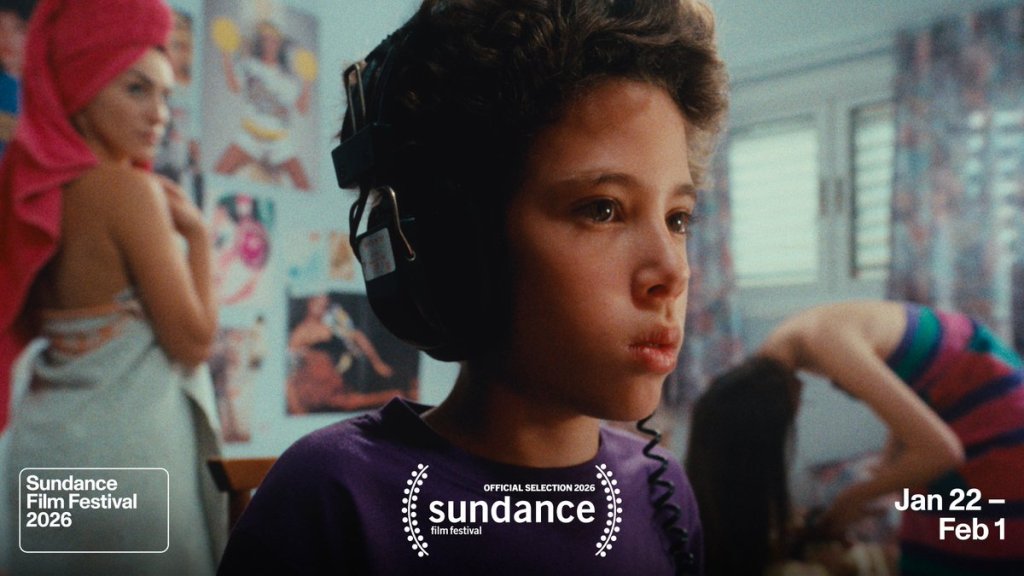
Writer/director Moshe Rosenthal has plumbed his personal memories to create a multigenerational film that explores culture, class, fear, and generational bonds. 12-year-old Boaz worships his father within his household surrounded by his mother and two older sisters. When he begins to question his father’s faultless love while inundated with misinformation and paranoia surrounding the growing AIDS epidemic in 1987 Israel, a rift forms that becomes a seismic event, fracturing the family. Boaz grows up disillusioned and angry as the film leaps to 1996, slamdancing his way through young adulthood searching for the father he’d thrown away. Flittering between his bar mitzvah and rebellious club nights, Boaz embodies the film’s title as he seeks total illumination in a world that obfuscates truth, scuttling reason and compassion in favor of rage and reaction.
ROCK SPRINGS
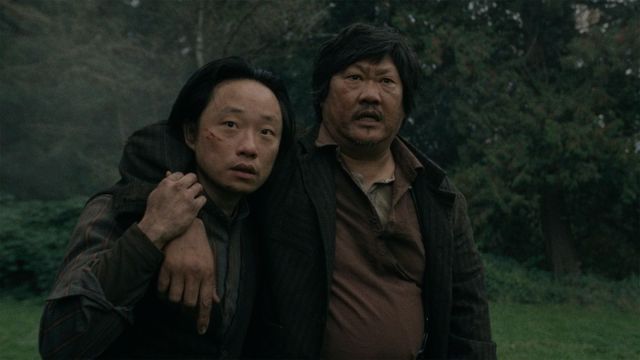
Writer/director Vera Miao’s ROCK SPRINGS does something that most horror allegories do not: it successfully blends social commentary with a compelling monster story. Oftentimes I’ll read a director’s statement and they’ll insist that all the gore and flesh-ripping is a metaphor for some recontextualization of a historical event or social construct, though all I can see is the gore and flesh-ripping. ROCK SPRINGS tells an actual digestible story of culture, generational trauma, and historical significance while still featuring a monster that will make you shit your pants if you linger too long on thoughts of its feasibility. Told in three parts and featuring excellent work from Kelly Marie Tran, Benedict Wong, and Jimmy O. Yang, ROCK SPRINGS speaks to the blurring of community through time and language that exists not only across regions but also within families. The monster is a bag of flesh containing multiple pains and a thirst for vengeance that chills the bones and turns the stomach, though ultimately invites us towards forgiveness and compassion. This is a film that will get people talking.
HOT WATER
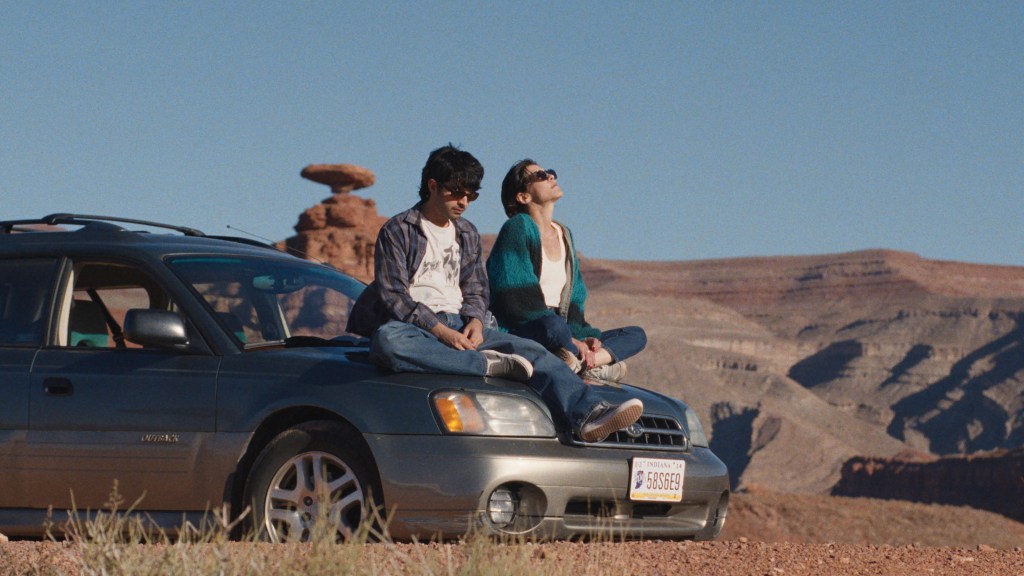
Written and directed by Ramzi Bashour, HOT WATER tells the story of beleaguered immigrant Layal as she’s torn between longing calls from her sister and mother back in Beirut and caring for her American-born son Daniel and his frequent transgressions. An older high-schooler thanks to several setbacks, Daniel is expelled from his Indiana high school for an outburst of violence and set further off track for graduation. A solution presents itself when his estranged father in California offers a room and late enrollment to finish his high school career. A spontaneous road trip pairs the mother and son as they cross borders and barriers across America and between themselves. Filled with humor, colorful characters, temporary tattoos, and more nudity than you’d imagine in a film of such heartfelt sincerity, HOT WATER exemplifies the Sundance spirit of brave storytelling with surprisingly wide relatability.
BIG GIRLS DON’T CRY
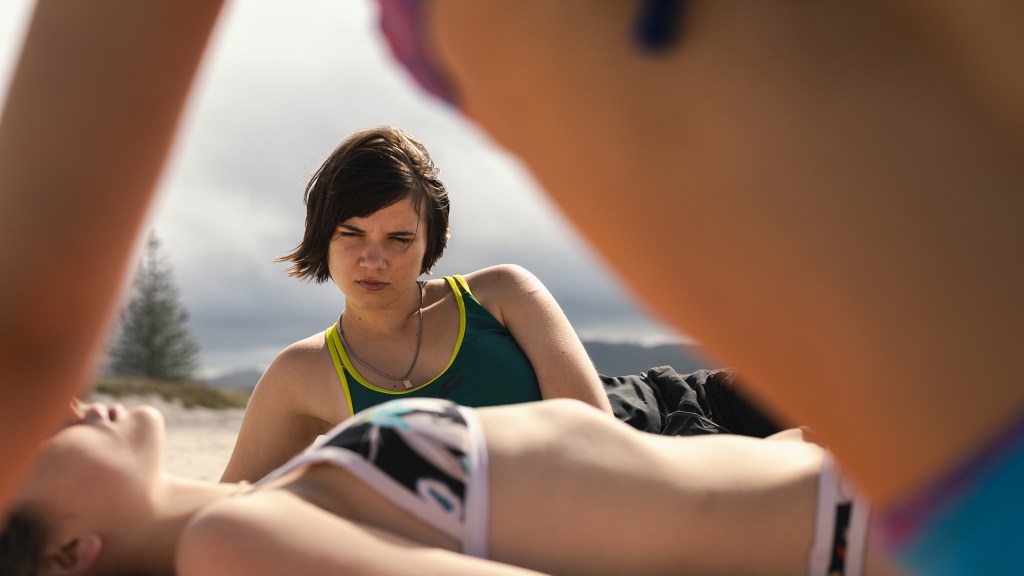
A period piece set in the ancient time of 2006 in a rural area of New Zealand, BIG GIRLS DON’T CRY centers around 14-year-old Sid, played with awkward authenticity by Ani Palmer. Sid is on winter break from school and looks forward to spending time with her sister Adele, also home from University, who has brought along her American friend Freya. Sid is in a hurry to grow up, ushered along by rumors of her promiscuous friends, masturbatory internet chats, and her own wandering eyes. Through lies, imitation, and manipulations, Sid gets in way over her head as she dances with one foot in childhood and another in fast-approaching adulthood. By the end she is shunned from both worlds, just as her body is giving her a definitive answer on which direction time ultimately moves. This debut feature from writer/director Paloma Schneideman is hyper-specific to its geographic location while universally approachable to every viewer who has asked themselves who they are while trying to measure such by the yardstick of a fractured, imperfect world.
EXTRA GEOGRAPHY
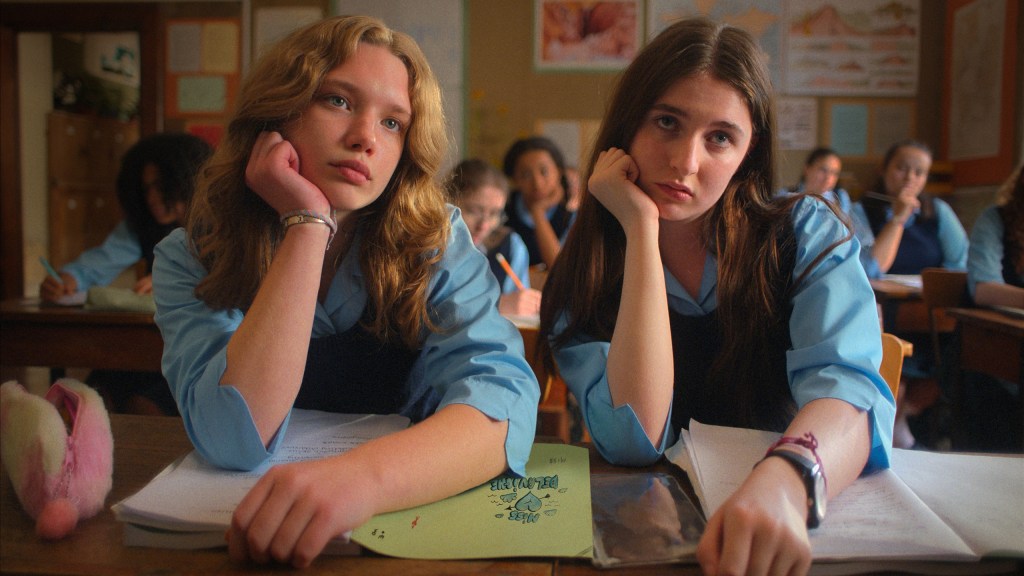
Another coming-of-age story, this one set in a boarding school in England, EXTRA GEOGRAPHY moves with a much swifter pace than BIG GIRLS DON’T CRY due to the interplay and comedic timing of its two central leads. Marni Duggan and Galaxie Clear star as Flic and Minna, two overachievers who are best friends in sync in every way. They excel at every endeavor to which they turn their hand, so when they decide that their summer project should be to fall in love, as it will make them worldly, they attack the problem with the same doggedness and determination that they would any academic task. At the same time, the neighboring boys school is partnering for the summer play, a staging of Shakespeare’s ‘A Midsummer Night’s Dream,” which introduces a new challenge. The film is laugh-out-loud funny thanks to the chemistry of the co-leads and Molly Manners’s distinct directorial style, though it still manages to capture the disappointment of growing up as compatriots become competitors and achievements become milestones that separate us from our youth. Written for the screen by Miriam Battye and adapted from a short story by Rose Tremain, EXTRA GEOGRAPHY is a crowd-pleasing examination of friendship, discovery, and inevitable growth.
NIGHT NURSE
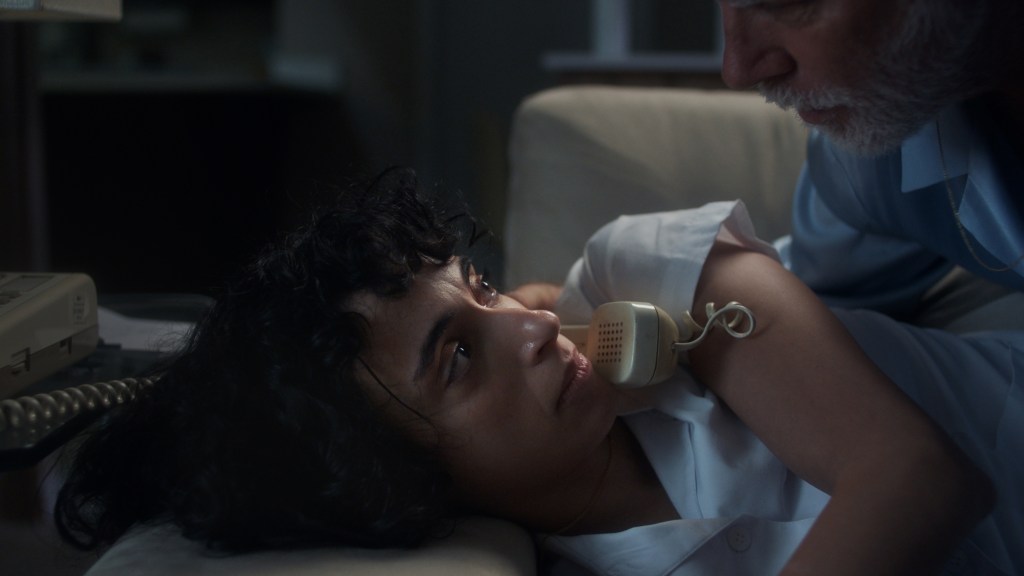
Written and directed by Georgia Bernstein, Night Nurse tells the story of Eleni, a career dropout who is hired to work as the titular night nurse to a particularly bothersome resident in a senior community. The film takes place in some bizarre period of landlines, MRI machines, and inept police as her patient, Douglas Callum, uses his nurses as pawns in his schemes to con his fellow seniors through scam phone calls. Eleni is more than willing to be an accomplice, a wet blanket that appears to be used to being used. I personally hated this film due to its repugnant characters, appalling subject matter, and glacial pacing. It did teach me something about myself, however: I can understand evil – a person exercising their wicked will regardless of moral or ethical hurdles – but I can’t understand weakness – those who kowtow to charm or coercion and engage in harmful behavior for the sake of ease or the opiate of acceptance. Night Nurse is a sick film for sick people.
BARBARA FOREVER
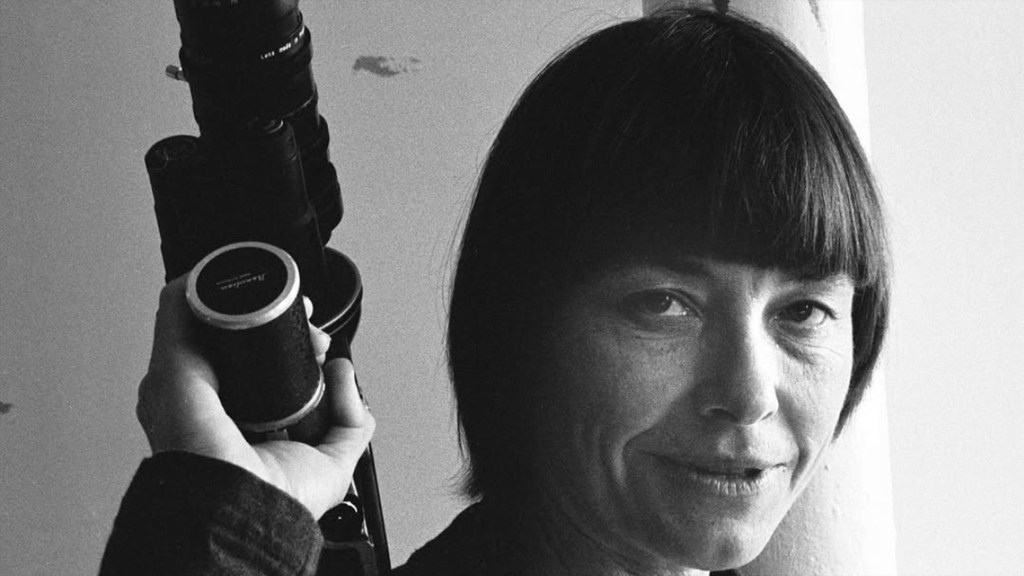
Prior to screening this film I had never heard of Barbara Hammer, pioneering lesbian filmmaker, but Brydie O’Connor’s deep and deeply personal dive into her work has changed that. I know I’m not Barbara’s target audience, as her intent was to catalogue her life as a lesbian for the sake of authenticity and honesty. To paraphrase her approach, “if we don’t represent ourselves then we will be misrepresented.” Hammer’s films were composed as art, not commercial fare, and composed from a female gaze, unconcerned with propriety or public opinion. The result is work that is uncomfortably intimate; through her exhibition she makes the audience voyeurs, whether we’ve fancied ourselves as such or not. I often find film as art to be pretentious and esoteric and her work was no exception, though I do appreciate its role in history (or herstory) as a declaration of self-acceptance, representation, and personal documentation. Never one to separate herself from the art, Barbara Hammer resonates as an inspiration for all artists choosing to live their art and document their truth.
SILENCED
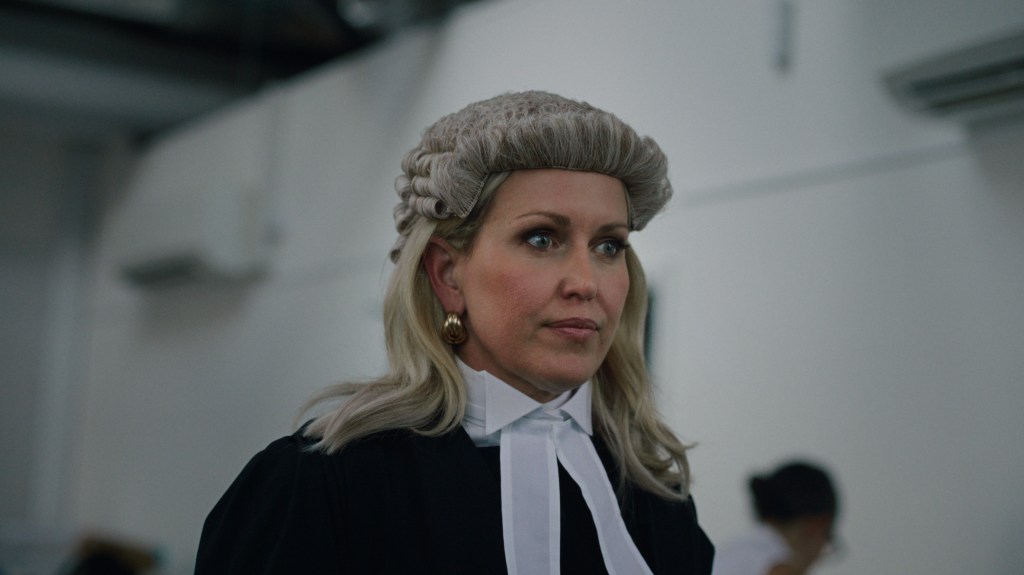
We’ve all found ourselves in the situation where we’re headed to an important meeting and don’t know what to wear. Brittany Higgins had to consider such a decision while defending her accusations against her attacker who was suing her for defamation, noting she had to be sure to be “putting on clothes that make you look rapeable but also respectable.” That is the abhorrent reality presented in Silenced, a film by Selina Miles that demonstrates the difficulties that arise when women who speak out against sexual assault are slapped with defamation suits. The film covers suits levied in London, Mexico City, Johannesburg, Canberra, and Fairfax, from movie starts to the countless nameless women railing against a patriarchal system that categorically labels them as property. Led by Human Rights Lawyer and Barrister Jennifer Robinson, this Australian documentary tells a global tale that calls out an ongoing imbalance of justice that affects half of all humanity. It’s historical, timely, and prescient and should spur global conversation around the topic of gender power dynamics.
SEIZED
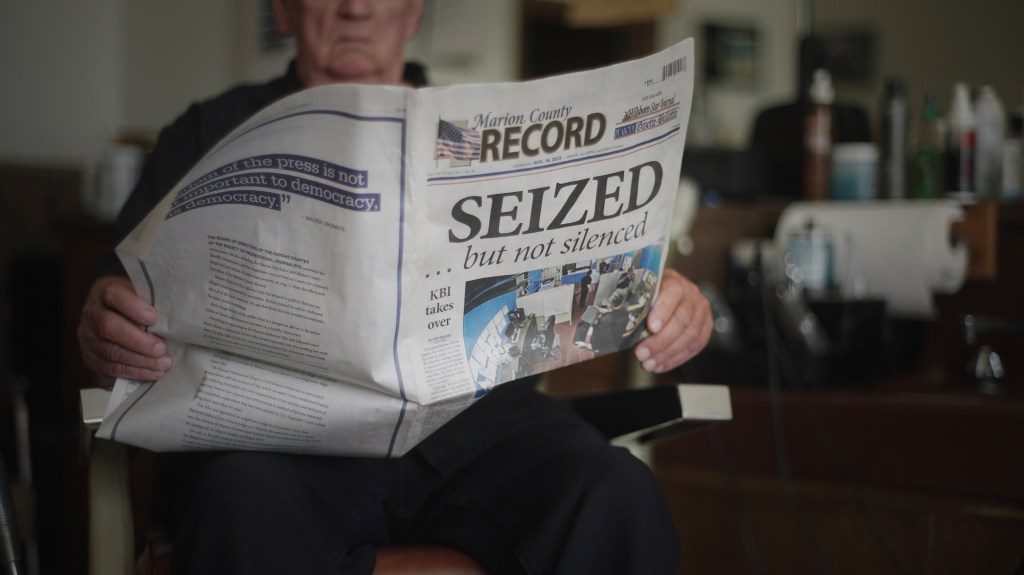
Director Sharon Liese has a long history of shining a light on Americans’ battles against their own institutions. In Seized, she looks into the story that grabbed the nation’s attention back in 2023: local police in Marion County raided the local paper, The Record, as well as the home of its editor and owner, seizing hard drives, phones, and more. The next day, the paper’s co-owner, a 98-year-old op-ed writer, died from the stress of the raids. A nation held its breath as what appeared to be a local executive overreach and a blatant First Amendment violation resulted in a shining spotlight and a corpse.
Liese wanted to know more, and found her in with Finn Hartnett, a new hire at The Record a year after the infamous raid. We the viewers follow Finn into the bullpen as the ripples continue to cross the community and the nation. Liese’s documentary tries to convey objectivity as the townspeople paint The Record’s standing Editor-in-Chief Eric Meyers as a dogged bully of a reporter, but her allegiance to the First Amendment continues to paint him as a man of principle. Seized serves as a fill-in-the-blank primer for those who hadn’t looked past the headline a few years back and also delivers a Southern-Fried gothic whodunit of small-town secrets and lies. I found a villain of my own watching this film, and I’m curious as it gets a wider release if others may see it the way I do. It’s definitely a juicy bit of curio and I’m sure it’ll get people talking in Park City and beyond.
PUBLIC ACCESS
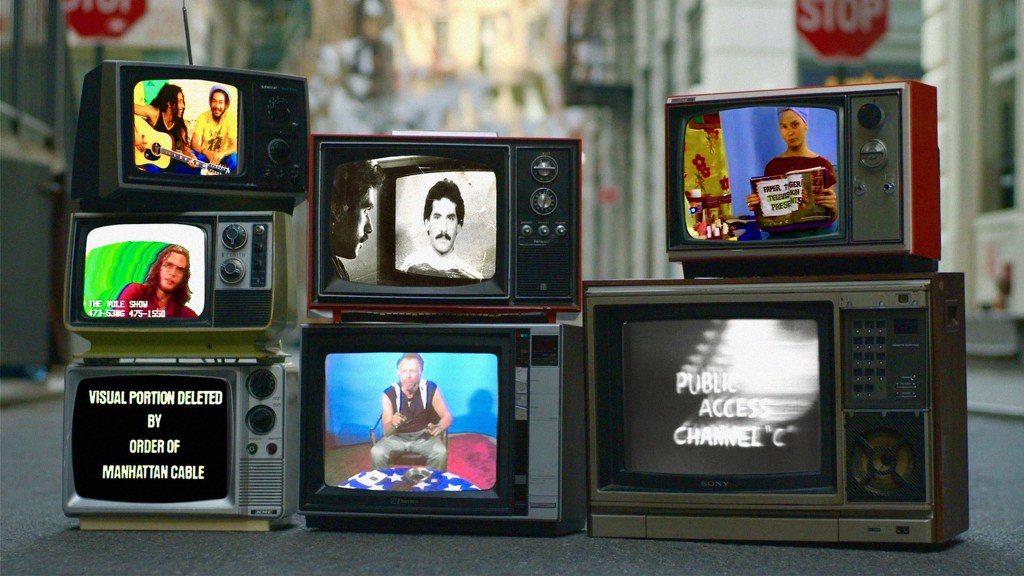
David Shadrack Smith’s Public Access seems like it would be a timely examination of the importance of Public Access television at a time when government funding to Public Broadcasting has been slashed. This, however, has proved to be an inconsistent, but not uncommon, thought process as these two entities are vastly different. Public Access television is of interest to us, however, as our program No Rest for the Weekend broadcasts on Public Access stations in Manhattan and Brooklyn weekly.
Smith’s lens is a wide one that begins all the way back in 1971 when the Public Access Channels were originally mandated by Time Warner Cable in Manhattan as the service became a common carrier. Earlier adopters saw the opportunity to allow community members to speak their piece to their neighbors and the powers on high as recording and broadcasting equipment became plentiful and intuitive. Soon a new landscape of programming appeared on local broadcasts where anyone with a few hours of time and an idea could have a show on the boob tube, and community expression quickly devolved into the basest of human interests. It’s the age old question of “If you could say anything, what would you say?” These channels quickly became minefields of scripture, porn, and avant poetry. As viewers and censors began to push back, the question of free speech became paramount, and the debate raged.
One of the film’s most poignant observations actually came from one of early Public Access’s purveyors of filth, Al Goldstein. When asked how he could justify hijacking an avenue that had been secured for minorities to fill it with perversion he asked, “Has it ever occurred to you that those you would label as perverts and degenerates might see themselves as minorities among you?” Smith’s thoughtful documentary demonstrates how marginalized groups have used Public Access to give themselves a voice to cut through the ignorance and ignominy of mainstream media and become voices of their own movements. Featuring interviews with members of Blondie, queer trailblazers, reality programming pioneers, and more, Public Access is a view into creator culture long before the dawn of YouTube or TikTok.

 Eric McClanahan